
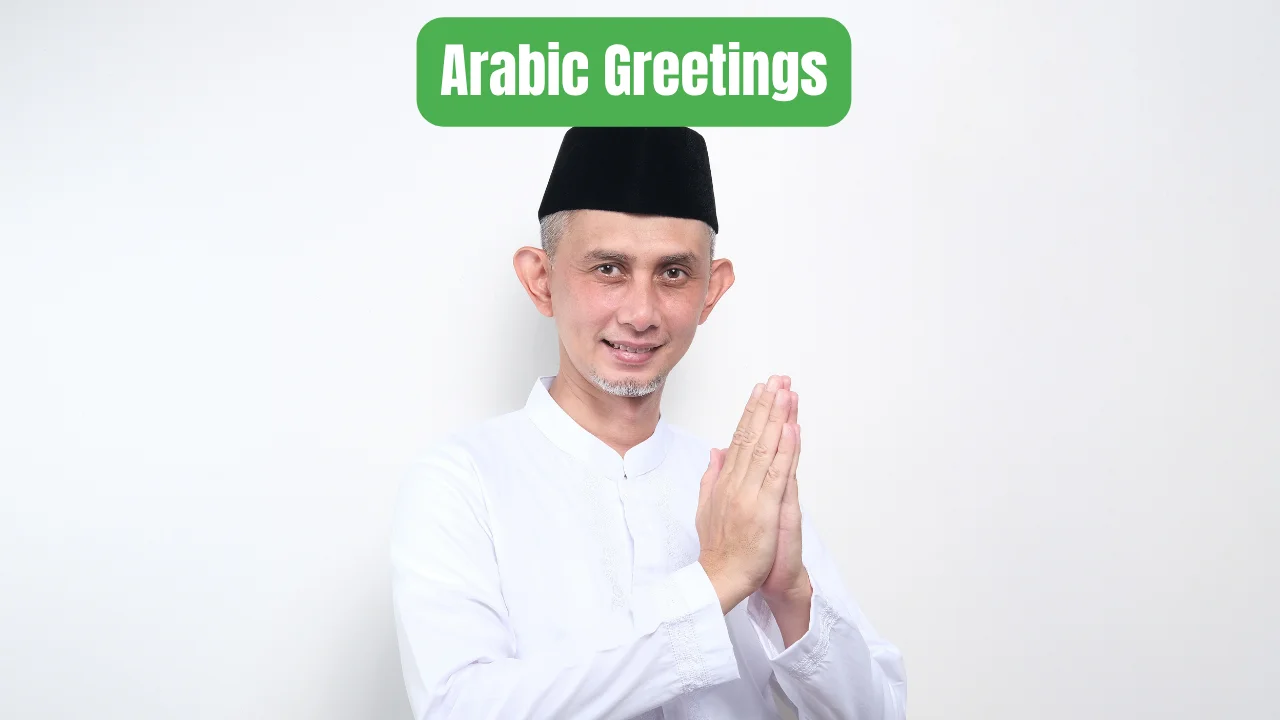
Learning Arabic greetings is a wonderful way to start meaningful conversations and show respect for Arabic culture. Whether you’re traveling, studying, or meeting Arabic speakers, knowing a few common Arabic greetings can make every interaction feel more natural. Simple words such as Marhaba and Ahlan can help you greet people confidently. You can also learn traditional expressions used in religious and formal settings. Understanding Arabic greeting phrases with their English meanings and proper context makes them easier to remember.
From friendly hellos to respectful welcomes, Arabic offers many expressions that reflect warmth, hospitality, and connection. Even a few well-practiced phrases can make your conversations feel more genuine and welcoming.
Arabic Greetings and Their Meaning
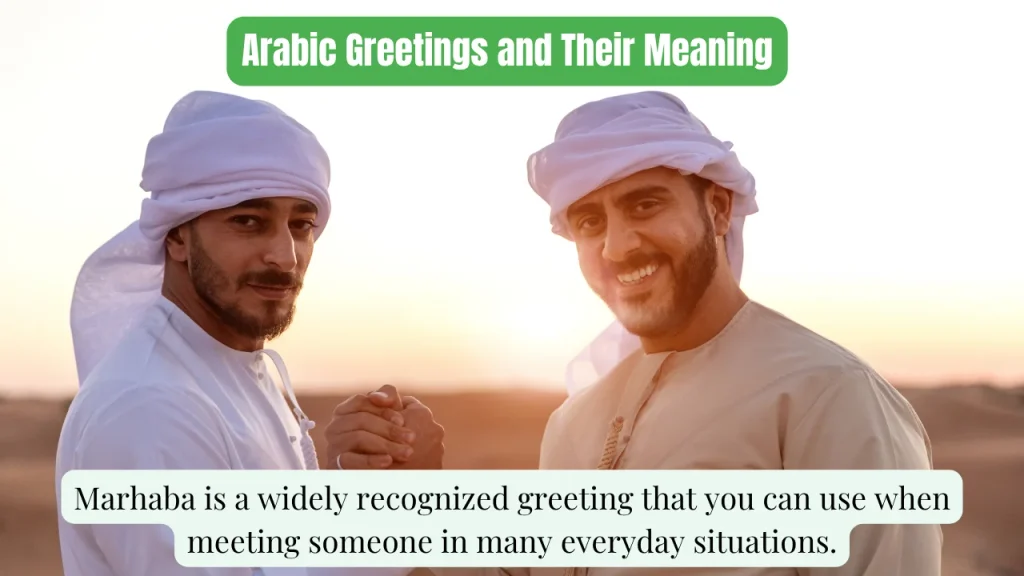
Arabic greetings carry more meaning than a simple “hello.” They often communicate kindness, respect, peace, welcome, or interest in another person’s wellbeing. The exact expression depends on your relationship, setting, and regional dialect. Understanding that context helps you choose polite Arabic phrases without sounding overly formal or strangely familiar.
Understanding Common Arabic Greeting Words
The Arabic language includes several everyday expressions that English speakers may hear frequently. Marhaba, Ahlan, and Marhaban can all function as greetings, although their usage and tone can vary. Meanwhile, Ahlan wa sahlan carries a warmer welcoming sense and often appears when someone receives a guest.
Ten Useful Arabic Greetings and Their Meanings
- Marhaba is a widely recognized greeting that you can use when meeting someone in many everyday situations.
- Marhaban offers a slightly more formal-sounding version and works well when you want a courteous opening.
- Ahlan feels friendly and natural, especially when greeting someone you already know or feel comfortable with.
- Ahlan wa sahlan expresses a warm welcome and can make a visitor feel genuinely received.
- As-salamu alaykum literally conveys peace be upon you, making it an important traditional Islamic greeting.
- Sabah al-khayr means good morning and provides a pleasant way to begin daytime conversations.
- Masa al-khayr means good evening and suits conversations that begin later during the day.
- Ahlan bik offers a friendly welcome when speaking directly to one person in many Arabic-speaking contexts.
- Ya hala sounds warm and welcoming and appears frequently in informal conversations across several regional varieties.
- Kifak or Kifak? can introduce a personal wellbeing question after greeting someone in several dialects.
Also Read: Seasons Greetings
Common Ways to Say Hello in Arabic
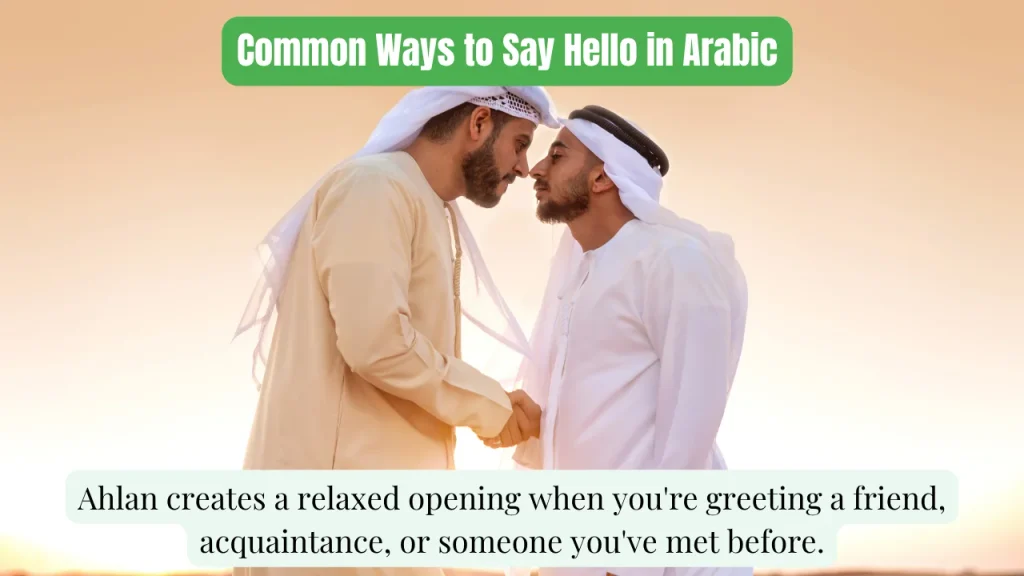
Learning how to say hello in Arabic doesn’t require memorizing dozens of expressions immediately. Start with a few versatile phrases and understand where they fit. Hello in Arabic can change according to region, relationship, and formality. That’s why language learners should study actual situations rather than isolated vocabulary.
Everyday Greetings for Beginners
For beginners, basic Arabic greetings such as Marhaba and Ahlan provide an easy starting point. They don’t require complicated grammar, and native speakers commonly understand them. If you’re wondering how to greet someone in Arabic, begin with a simple expression, smile naturally, and continue with a question about their wellbeing.
Ten Everyday Arabic Greeting Examples
- Marhaba works as a straightforward everyday greeting when you meet someone casually at a shop, workplace, school, or social gathering.
- Ahlan creates a relaxed opening when you’re greeting a friend, acquaintance, or someone you’ve met before.
- Marhaban gives your greeting a courteous tone while remaining simple enough for a beginner to remember.
- Ahlan wa sahlan works beautifully when welcoming somebody into your home, office, classroom, or social space.
- Hi in Arabic can also be expressed through casual regional words that vary considerably between different Arabic-speaking communities.
- Hello in Arabic doesn’t always translate into one universal expression because Arabic dialects contain many regional alternatives.
- Ahlan fik can sound welcoming and friendly when addressing someone in informal conversation within several dialect communities.
- Ya marhaba can express an enthusiastic welcome when someone arrives unexpectedly or returns after being away.
- Ahla w sahla appears in colloquial speech as a warm greeting, particularly when someone wants to make another person comfortable.
- Kif halak? adds “How are you?” to the greeting and naturally turns a simple hello into conversation.
Also Read: Spanish Greetings
Islamic and Traditional Arabic Greetings
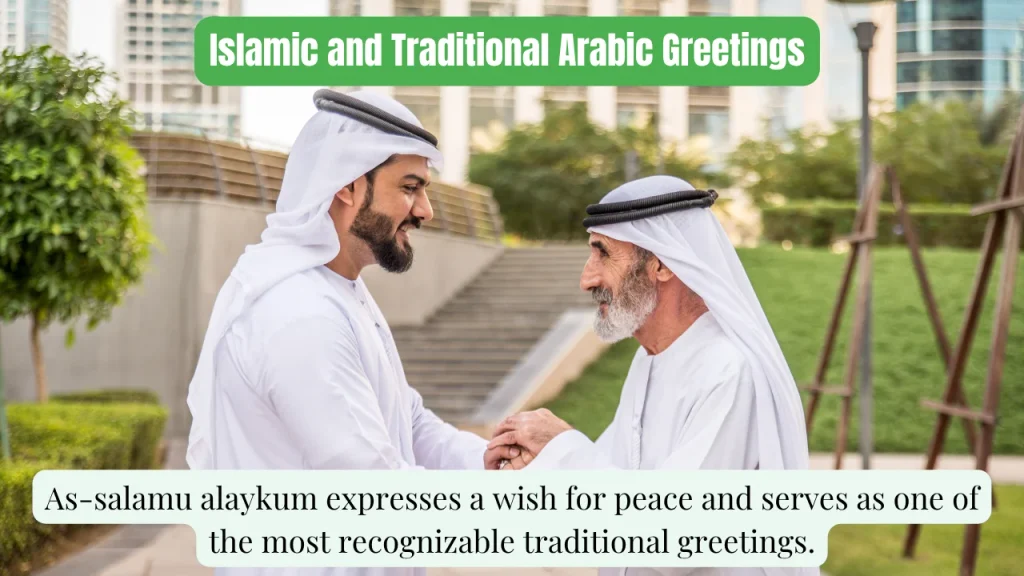
Some Islamic greetings in Arabic have deep religious and cultural importance. The most recognizable example is As-salamu alaykum, which means “peace be upon you.” The customary response is Wa alaykum as-salam, meaning that peace also be upon you. These expressions extend beyond ordinary small talk.
The Meaning of As-Salamu Alaykum
The phrase As-salamu alaykum comes from Arabic words associated with peace and safety. Muslims commonly use it when meeting one another. You’ll hear it in homes, mosques, workplaces, classrooms, and community settings. Its importance comes from both linguistic tradition and Islamic practice.
Ten Traditional and Islamic Greeting Examples
- As-salamu alaykum expresses a wish for peace and serves as one of the most recognizable traditional greetings.
- Wa alaykum as-salam provides the customary Arabic greeting response to someone who offers the peace greeting first.
- As-salamu alaykum wa rahmatullahi wa barakatuh expands the greeting by wishing peace, mercy, and blessings from Allah.
- Wa alaykum as-salam wa rahmatullahi wa barakatuh gives the corresponding extended response with the same respectful religious tone.
- Ahlan wa sahlan can welcome a guest warmly while maintaining a culturally familiar traditional character.
- Marhaban bik can express welcome toward a person arriving somewhere and often sounds hospitable in social situations.
- Barakallahu fik isn’t simply hello, yet it can accompany respectful religious conversation and express appreciation.
- Jazakallahu khayran means may Allah reward you with goodness and often appears in courteous Islamic interactions.
- Allah yisallmak can express a warm wish for someone’s safety in several colloquial Arabic settings.
- Allah yihafzak conveys a protective good wish and can accompany friendly or respectful conversations in regional dialects.
Arabic Greetings With Responses
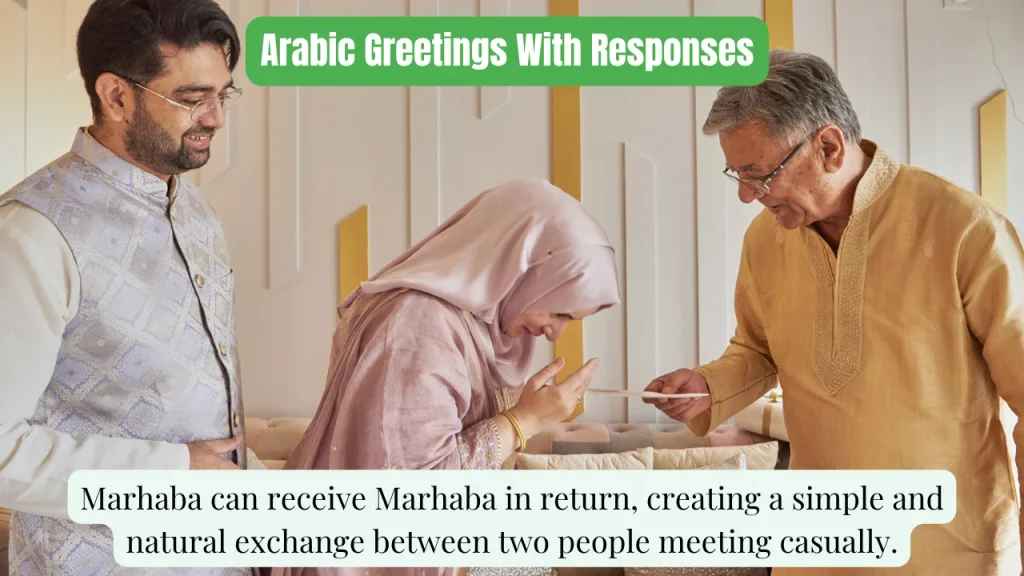
Knowing a greeting without knowing its response can leave you searching for words. Fortunately, many Arabic greetings and responses follow familiar patterns. Learning both sides creates confidence because you won’t freeze after someone greets you first. Think of these exchanges as conversational building blocks.
Common Greeting-and-Response Patterns
The classic example is As-salamu alaykum followed by Wa alaykum as-salam. Other expressions work more flexibly. Someone might say Marhaba and receive Marhaba in return. A greeting can then continue with how are you in Arabic, creating a natural conversation rather than ending after one phrase.
Ten Greeting and Response Examples
- Marhaba can receive Marhaba in return, creating a simple and natural exchange between two people meeting casually.
- Ahlan can receive Ahlan wa sahlan, especially when the second speaker wants to sound particularly welcoming.
- As-salamu alaykum should normally receive Wa alaykum as-salam, maintaining the established Islamic greeting pattern.
- Sabah al-khayr commonly receives Sabah an-noor, creating a pleasant morning exchange between Arabic speakers.
- Masa al-khayr can receive Masa an-noor, providing a familiar evening greeting exchange.
- Kifak? can receive a response describing wellbeing before the conversation naturally moves toward another subject.
- Ahlan wa sahlan may receive a warm thank-you or reciprocal welcome when someone enters a home.
- Ya hala can receive another welcoming expression when friends meet after spending time apart.
- Marhaban bik may receive an appreciative response when someone welcomes you into their home or gathering.
- How are you in Arabic often follows a greeting and helps transform a brief exchange into friendly conversation.
Also Read: Friday Greetings
Formal Arabic Greetings for Respectful Situations
Formal Arabic greetings matter when you’re speaking with a manager, professor, government official, older person, client, or unfamiliar guest. The phrase itself isn’t always dramatically different. Instead, your word choice, tone, title, and overall manner create the appropriate level of respect.
Professional and Respectful Situations
In Modern Standard Arabic, formal language appears in writing, official communication, education, media, and formal speeches. Everyday spoken Arabic usually relies more heavily on local dialects. When you’re unsure about someone’s preferred level of formality, starting respectfully is usually a sensible linguistic choice.
Ten Formal Greeting Examples
- As-salamu alaykum provides a respectful opening for many professional or formal interactions involving Muslim Arabic speakers.
- Marhaban can serve as a courteous greeting when you’re meeting someone unfamiliar in a professional environment.
- Ahlan wa sahlan warmly welcomes a visitor while still sounding appropriate during many formal social occasions.
- Sabah al-khayr offers a polite morning opening for professional conversations, meetings, appointments, and workplace interactions.
- Masa al-khayr provides a courteous evening greeting when a formal conversation begins later in the day.
- Tasharrafna communicates the pleasure of meeting someone and can follow an introduction in respectful social situations.
- Ahlan wa sahlan wa marhaban creates an especially warm welcome for an honored visitor or important guest.
- As-salamu alaykum, ustadh combines a respectful greeting with a suitable title when addressing a teacher or educator.
- As-salamu alaykum, sayyidi can convey respect toward a man in contexts where this form of address fits.
- Ahlan wa sahlan, wa shukran li-hudurikum can welcome attendees politely during organized meetings, events, or gatherings.
Warm and Friendly Arabic Greetings
Friendly conversation gives you more freedom. Informal Arabic greetings often sound shorter, livelier, and more personal than formal expressions. Regional speech becomes especially important here. A greeting between close friends in Egypt may sound noticeably different from one heard among friends in Lebanon or the Gulf.
Casual Greetings for Friends and Family
When choosing Arabic phrases for friends or Arabic phrases for family, focus on familiarity rather than perfect textbook Arabic. Your facial expression and tone matter too. A simple phrase delivered warmly can feel more natural than an elaborate sentence delivered stiffly.
Ten Warm and Friendly Greeting Examples
- Ahlan ya sadiqi creates a friendly greeting for a male friend and directly communicates familiarity and affection.
- Ahlan ya sadiqati offers a similar warm greeting when speaking to a female friend in appropriate Arabic.
- Ya hala wallah can sound especially welcoming among friends and appears in several regional conversational varieties.
- Ahlan wa sahlan ya habibi offers an affectionate welcome when speaking warmly with a close male friend.
- Ahlan wa sahlan ya habibti provides a similarly affectionate expression when addressing a close female friend.
- Kifak ya sadiqi? combines a friendly greeting with genuine interest in how your male friend feels.
- Kifik ya sadiqati? creates a friendly opening while asking a female friend about her wellbeing.
- Sho akhbarak? asks what’s new and works naturally among friends in several Arabic dialects.
- Shu hal-ghaybeh? can jokingly acknowledge someone’s absence when a friend finally returns after some time.
- Nawwart el-makan warmly tells someone that their presence has brightened the place after arriving.
Greetings for Different Times and Occasions
Arabic has specific expressions for different parts of the day. Sabah al-khayr means good morning while Sabah an-noor commonly answers it. Similarly, Masa al-khayr means good evening and Masa an-noor provides a familiar response. These expressions are among the most useful time-based greetings.
Morning and Evening Arabic Greetings
If you’re learning good morning in Arabic, remember the paired response as well. The same approach works for good evening in Arabic. Learning greetings as conversational pairs makes recall easier because your brain connects the phrases through a real interaction.
Ten Time-Based and Occasion-Based Greetings
- Sabah al-khayr offers a cheerful morning greeting and fits many everyday conversations before or during the day’s early hours.
- Sabah an-noor provides the familiar response to the morning greeting and adds a bright, welcoming tone.
- Masa al-khayr introduces an evening conversation with a courteous expression used across many Arabic-speaking communities.
- Masa an-noor commonly answers the evening greeting and creates a balanced conversational exchange.
- Ramadan kareem offers a warm Ramadan greeting that wishes generosity and blessing during the holy month.
- Eid mubarak congratulates someone during Eid and remains one of the most recognizable Arabic celebration expressions.
- Kul sana wa anta tayyib can express good wishes for someone’s happiness and wellbeing during birthdays or special occasions.
- Marhaban bik fi baytina welcomes someone warmly into your home and emphasizes hospitality during personal visits.
- Ahlan wa sahlan fi baladna welcomes visitors to your country or community with a generous and hospitable tone.
- Ma’a as-salama provides a common farewell expression when ending a conversation or saying goodbye.
Arabic Greeting Etiquette and Cultural Tips
Words matter, but Arabic cultural etiquette extends beyond vocabulary. Greetings can involve handshakes, smiles, nods, titles, hospitality, and awareness of personal boundaries. Practices differ across countries and families. Therefore, avoid treating one custom as universal across every Arabic-speaking community.
Understanding Regional and Social Differences
Arabic dialects can change greetings considerably. Egyptian Arabic greetings, Levantine Arabic greetings, and Gulf Arabic greetings may use different vocabulary or pronunciation. Age, gender, religion, location, and familiarity can also influence the interaction. Listening first can save you from an awkward linguistic misstep.
Ten Practical Greeting Etiquette Examples
- Greeting elders in Arabic generally calls for respectful language, appropriate titles, and a considerate tone rather than overly casual expressions.
- Greeting guests in Arabic often involves welcoming language that emphasizes hospitality, comfort, and genuine pleasure at their arrival.
- Arabic social etiquette encourages attentive greetings because ignoring someone entering a gathering can appear noticeably unfriendly.
- Arabic greeting customs differ across regions, so observe local behavior before copying gestures or physical contact.
- Respectful Arabic greetings work particularly well when meeting older people, professionals, teachers, or unfamiliar community members.
- Casual Arabic greetings suit close friends and relatives, although regional vocabulary may change depending on your location.
- Religious Arabic greetings deserve respectful pronunciation because their meaning carries spiritual and cultural significance.
- Arabic phrases for strangers should usually remain courteous until you understand the relationship and preferred conversational style.
- Arabic farewell phrases can be just as important as greetings because conversations often end with another expression of goodwill.
- Arabic pronunciation deserves attention because small sound differences can change how clearly your greeting reaches the listener.
Arabic Greetings in English: Quick Reference
A compact reference table makes Arabic greetings in English easier to study. Arabic script shows the original expression while transliteration helps English readers pronounce it. Remember that transliteration isn’t perfectly standardized. Different books and websites may represent the same Arabic sounds differently.
Arabic Greetings Cheat Sheet
| Arabic Greeting | Transliteration | English Meaning | Typical Use |
| مرحباً | Marhaban | Hello | General greeting |
| مرحبا | Marhaba | Hello | Everyday use |
| أهلاً | Ahlan | Hello / Welcome | Casual situations |
| أهلاً وسهلاً | Ahlan wa sahlan | Welcome | Warm welcome |
| السلام عليكم | As-salamu alaykum | Peace be upon you | Islamic/traditional |
| وعليكم السلام | Wa alaykum as-salam | Peace be upon you too | Response |
| صباح الخير | Sabah al-khayr | Good morning | Morning |
| صباح النور | Sabah an-noor | Good morning | Morning response |
| مساء الخير | Masa al-khayr | Good evening | Evening |
| مساء النور | Masa an-noor | Good evening | Evening response |
A Simple Case Study for Learners
Imagine you’re visiting Dubai and entering a small family-owned shop. You don’t need an elaborate speech. A warm greeting followed by a polite question creates a natural beginning. If the shopkeeper responds with a familiar regional expression, listen carefully. You can then mirror their level of formality.
Now imagine a university meeting with an Arabic-speaking professor. The same casual approach may feel too relaxed. Starting with a respectful greeting and appropriate title creates a different social tone. The lesson is simple: language works best when vocabulary and context move together.
How to Learn Arabic Greetings Naturally?
The fastest way to remember Arabic greeting phrases is to connect each expression with a situation. Associate morning greetings with breakfast, welcoming expressions with visitors, and religious greetings with appropriate community settings. Practice complete exchanges rather than memorizing isolated words. That approach builds useful conversational memory.
Arabic greetings aren’t merely vocabulary items. They provide a doorway into Arabic communication, hospitality, and social relationships. Once you understand the difference between formal, casual, traditional, and regional expressions, choosing the right phrase becomes much easier. Start with a few reliable expressions, practice their pronunciation, and gradually explore local variations. With consistent practice, Arabic greetings for beginners can quickly become comfortable everyday language.
FAQs
How do you greet someone in Arabic?
You can say Marhaba or Ahlan for a friendly hello. As-salamu alaykum is another widely used respectful greeting.
What is the basic greeting for Muslims?
The basic Muslim greeting is As-salamu alaykum, meaning “peace be upon you.” The usual response is Wa alaykum as-salam.
What are the basic Arabic words?
Common beginner words include Marhaba (hello), Shukran (thank you), Na’am (yes), La (no), and Ahlan (welcome).
What is the most common greeting in Arabic?
As-salamu alaykum is one of the most widely recognized Arabic greetings. Marhaba and Ahlan are also common in everyday speech.
How to speak “I love you” in Arabic?
“I love you” can be expressed as Uhibbuka when addressing a male and Uhibbuki when addressing a female in Modern Standard Arabic.
How do I reply to salaam?
Reply with Wa alaykum as-salam, which means “and peace be upon you.” It’s the standard response to the Islamic greeting.
Also Read: Sunday Greetings
Conclusion
Learning Arabic greetings is a simple way to connect with Arabic-speaking people respectfully and naturally. From everyday expressions like Marhaba and Ahlan to traditional Islamic greetings, each phrase carries its own context and warmth. Understanding Arabic greeting phrases also helps you avoid awkward situations when speaking with friends, elders, colleagues, or strangers. Start with a few basic expressions, then gradually explore regional variations and pronunciation.
Remember that a genuine smile and respectful tone can make even simple words feel welcoming. With regular practice, you’ll become more comfortable using greetings in Arabic during travel, study, work, and everyday conversations. Arabic greetings aren’t just words; they’re an inviting doorway into meaningful communication.

Sophia Miller is a versatile writer who explores lifestyle, technology, business, health, and education topics. She is passionate about delivering clear, engaging, and informative content that helps readers stay informed and inspired.
4 thoughts on “Arabic Greetings: A Complete Guide to Saying Hello in Arabic”